
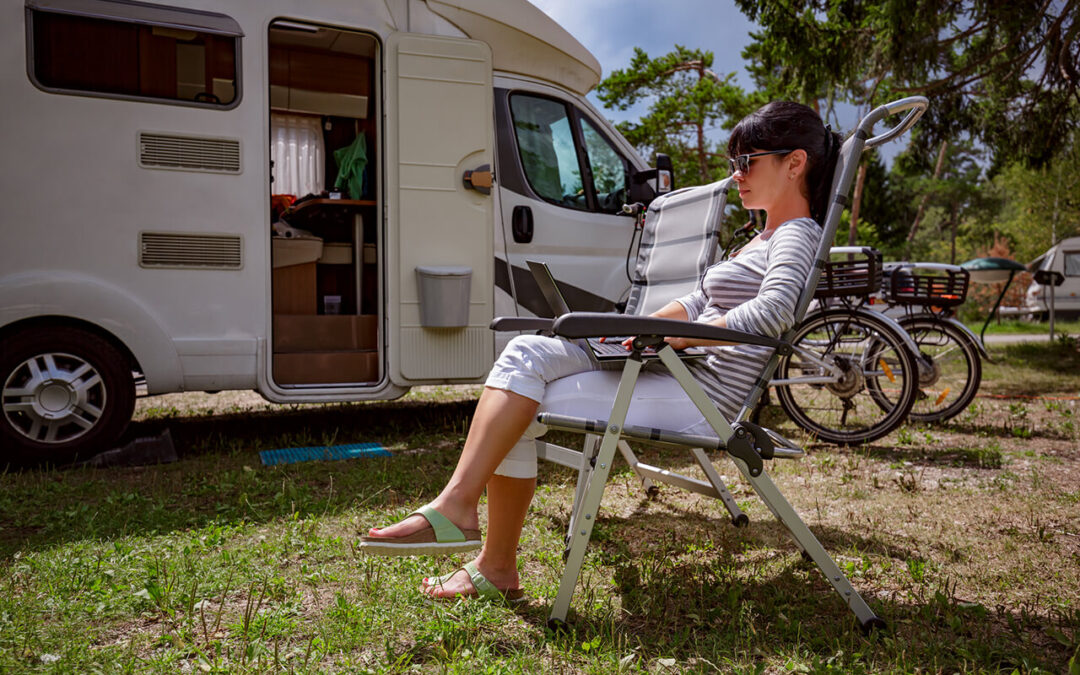
Solo RV travel is one of the most liberating ways to see the country. Most people who haven’t done it assume it’s lonely, complicated, or risky. Most people who have done it describe it as the opposite: deeply freeing, surprisingly social, and more manageable than they expected once they understood a few fundamentals. Traveling alone puts the itinerary entirely in the traveler’s hands: no compromises on destinations, no negotiations over schedules, no waiting for someone else to be ready. For the right person with the right preparation, it’s the most satisfying form of travel available.
What Solo RV Travel Actually Looks Like in Practice
Preparation matters in any RV trip, and it matters more in solo RV travel where there’s no co-pilot to share the navigation or troubleshooting. Route planning should account for realistic daily driving distances; solo drivers can’t share driving shifts, and fatigue is a more significant safety factor for a single occupant. Most experienced solo RV travelers recommend limiting daily driving to four to six hours, leaving time to arrive with daylight remaining and actually enjoy the destination rather than arriving exhausted. Sharing the day’s itinerary with a trusted contact who receives a daily check-in is the safety habit most experienced solo travelers adopt, and most new ones overlook.
The Social Reality of Traveling Alone
One of the most persistent misconceptions about solo RV travel is that it’s inherently isolating. Campgrounds are among the most naturally social environments available to travelers, and solo travelers consistently report meeting more people and forming more genuine connections on the road than when traveling with a companion, because traveling alone signals approachability in ways that groups don’t. The RV community is large, active, and well-connected through online groups and forums where routes, campgrounds, and experiences are shared freely. A traveler planning a first trip in an unfamiliar region can access detailed first-hand knowledge from experienced solo RV travelers who have covered the same routes.
The Practical Considerations That Make Solo RV Travel Work
The RV itself matters more in solo RV travel than in a shared trip, the traveler is the sole operator, sole mechanic, and sole decision-maker. A rig that can be backed into a standard campsite without a spotter and maneuvered in urban environments makes solo travel genuinely independent rather than stressful. Class B vans and smaller Class C motorhomes are disproportionately popular in the solo RV community for this reason. Basic mechanical knowledge is the investment that pays most in difficult moments; knowing how to change a tire, manage the electrical system, and troubleshoot common issues converts a breakdown from a stranding event into a manageable delay. A roadside assistance membership that covers RVs is the safety net that provides professional response when the situation exceeds what the solo traveler can handle independently.
Frequently Asked Questions (FAQs)
Is RV travel safe for first-time solo travelers?
Yes, with appropriate preparation. The risks most people worry about are manageable through route planning, campground selection, and the daily check-in habit. Choosing established campgrounds for the first few trips provides a built-in community and the security of neighbors. The first solo trip is almost universally described as the hardest and the one that most convinces new solo travelers they can do more.
What size RV is best for solo travel?
The most practical rigs are those the solo traveler can operate entirely independently, backing into sites without a spotter and driving four to six hours without excessive fatigue. Class B campervans are the most maneuverable and fuel-efficient option; smaller Class C motorhomes provide more amenities with still-manageable dimensions. Larger rigs can be operated solo but require more skill and limit access to tighter, more interesting camping locations.
How do independent travelers handle emergencies on the road?
A roadside assistance membership, basic mechanical knowledge, and a daily check-in habit with a trusted contact cover the majority of emergency scenarios. In remote locations, a satellite communicator device, which sends emergency signals regardless of cellular coverage, is the safety investment that provides coverage where a phone cannot.
How do solo travelers manage costs?
Solo RV travel costs more per person than a shared trip. Membership programs that reduce campsite fees, longer stays that reduce driving costs, and the flexibility to take advantage of free camping opportunities in real time are the most practical cost management approaches.
How do solo RV travelers stay connected and avoid loneliness?
The solo RV travel community is active and welcoming; online groups, forums, and in-person rallies provide connection both virtually and on the road. Most solo travelers find the campground environment more social than anticipated, and solitude when it occurs is typically a chosen, valued part of the experience rather than an unwanted side effect.
RV Home Inspections provides RV inspections in Houston, Texas. Contact us to schedule an appointment.
Recent Comments